

A translucent deep-sea jellyfish glowing teal, an artistic reflection on life and time
Longevity Science · Healthspan

Explore life.
Reimagine time.

Understanding aging, from the cell outward.
Exploring longer-lasting health and vitality through life science.

Introducing the Exoskeleton Series
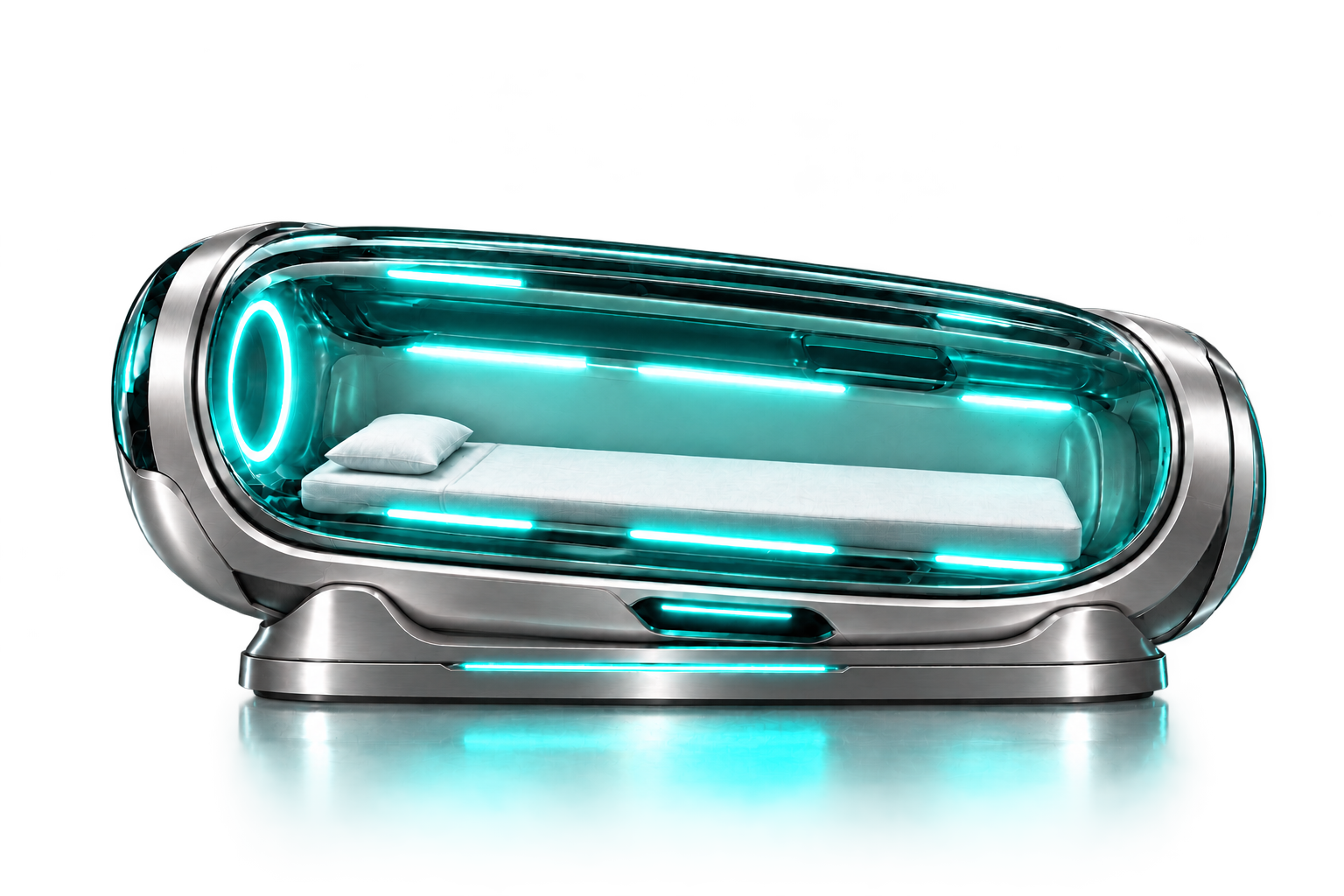
AEVUM horizontal recovery pod concept with a flat mattress and pillow
AEVUM · Product ConceptRecovery Pod
Discover the Pod
Scroll to Explore
Inspired by LifeLife's resilience inspires a new perspective on time.

As time moves forward,
let vitality move with it.

Understanding aging starts with cells.

We explore how cells change over time and how living systems maintain repair and balance. AEVUM connects fundamental life science with translational research, focusing on tissue repair, regenerative potential and biomarkers of aging in pursuit of a shared goal: healthspan.

Mechanism-led
Multiple Lines of Evidence
A Long-term View

The Recovery Pod.
Exploring multimodal wellness.

Exploring photobiomodulation, cellular microenvironments and bioelectric signals.
Connecting life science with immersive wellness design.

AEVUM pod exterior concept: horizontal body, flat mattress, transparent lid, bright silver titanium finish and teal lighting
Concept Illustration
01 / Concept Illustration

Reclining Interior & Flexible Pad

The transparent lid and horizontal pad illustrate the relationship between body support and interior space. Flexible conductive zones explore how distributed bioelectric stimulation could be integrated into the pad.

Horizontal SupportFlexible ElectrodesInterior Space
02 / Concept Illustration

Light Array & Optical Interface

Distributed light modules along the interior illustrate the proposed light sources, diffusers and transparent interfaces. Output uniformity, dose and temperature rise for red and near-infrared light require further validation.

PhotobiomodulationDistributed Light SourcesOptical Diffusion
03 / Concept Illustration

Air Circulation & Filtration

This cutaway illustrates the planned intake, filter, circulation and airflow channels. Temperature, humidity, air quality and airflow patterns require sensor calibration and engineering tests.

Airflow CircuitFilter AssemblyMicroenvironment Control
04 / Concept Illustration

Monitoring & Emergency Release

The concept combines basic physiological and operating-status displays with a clearly accessible mechanical release. Planned controls include feedback, fault shutdown and manual exit.

Monitoring FeedbackMechanical ReleaseManual Exit

Lid Hinge & Sealing Edge

A closer view of the proposed hinge, support mechanism and sealing edge connecting the transparent lid to the metal frame. Opening motion, durability and emergency exit still require engineering validation.

Flexible Pad & Layered Interface

The layered detail illustrates a flexible support surface, conductive textile, insulating interface and wiring channels. Contact consistency, output safety and cleaning durability are priorities for future validation.

AEVUM / Multimodal Wellness Concept

AEVUM · Recovery Pod

A whole-body immersive wellness concept informed by aging and tissue-repair research. The horizontal transparent pod is designed to explore the integration of photobiomodulation, a controlled microenvironment and flexible bioelectric stimulation.

Pure Titanium Design · Bright Silver Finish
The proposed metal structure features pure titanium with a fine brushed, clean satin finish. This is a concept prototype; material selection and manufacturing processes remain subject to development and validation.

PhotobiomodulationMicroenvironment ControlMonitoring & Feedback
01Multi-wavelength PBM

Planned red and near-infrared arrays, with a focus on dose and output uniformity.

02Controlled Microenvironment

Planned temperature, humidity, air filtration and circulation controls.

03Flexible Microcurrent Array

Exploring flexible pad electrodes and low-intensity bioelectric stimulation.

04Physiological Monitoring & Feedback

Planned basic physiological feedback, fault shutdown and emergency exit.

05Whole-body Mist & Dermal Delivery Research

A proposed fine-mist environment for uniform body-surface coverage and research into formulation contact with skin. Effectiveness and safety remain unverified.

Technical Plans & Product Notes
01Multi-wavelength PBM

Distributed arrays are planned around red and near-infrared photobiomodulation (PBM) research, with an interest in mechanisms related to mitochondrial energy metabolism and tissue repair.

02Controlled Microenvironment

System design focuses on temperature, humidity, air circulation and filtration. Oxygen partial-pressure control remains an unvalidated research direction exploring the relationship between environment and cellular homeostasis.

03Flexible Microcurrent Array

The pad is intended to incorporate distributed flexible electrodes for research into low-intensity bioelectric stimulation and signals associated with tissue repair.

04Physiological Monitoring & Feedback

Planned heart-rate, respiratory and skin-temperature monitoring would inform parameter adjustment, fault shutdown and emergency release in a monitoring-adjustment-feedback control loop.

05Whole-body Mist & Dermal Delivery Research

Proposed storage, atomization, mist distribution and collection modules would create a fine-mist environment for studying specific formulations in contact with skin. Design must address droplet distribution, formulation compatibility, cleaning and unintended inhalation. Skin penetration, repair effects and safety remain unverified; this does not establish whole-body repair.

Candidate research wavelengths include 630 nm red, 830 nm near-infrared and 465 nm blue light. Mechanisms and suitable applications require separate validation. Basic physiological monitoring does not directly measure aging, inflammation or oxidative-stress biomarkers.

This product is a concept prototype. Features describe technical plans and hypotheses informed by published research, rather than validated device performance or clinical benefits. It is not intended to diagnose or treat disease and does not promise age reversal. Specifications, conditions of use and safety require validation.

PBM reference: systematic review of LED trials in dermatology ↗

Made to move.
Designed around you.

FOUR CONCEPTS. ONE DESIGN LANGUAGE.

From the hand to the hip, a coordinated exploration of wearable support. Clean metallic forms, graphite textiles and quiet teal details connect the collection.

Explore the Recovery Pod
AEVUM EXO / H1Design Concept

Hand & Wrist

H1

An external hand-and-wrist concept that follows the back of the hand, leaving the palm open and the fingers visible.

  • Articulated finger guides
  • Open-palm layout
Design Details Click to enlarge
AEVUM EXO / A1Design Concept

Elbow & Forearm

A1

A joint-led upper-limb concept, bringing a sculpted elbow interface together with adjustable upper-arm and forearm cuffs.

  • Elbow-centered interface
  • Adjustable cuffs
Design Details Click to enlarge
AEVUM EXO / S1Design Concept

Shoulder Support

S1

A bilateral shoulder concept linking articulated upper-arm supports to a compact back structure and a soft waist interface.

  • Bilateral arm supports
  • Linked harness structure
Design Details Click to enlarge
AEVUM EXO / B1Design Concept

Back & Hip

B1

A back-and-hip concept connecting a slim central backplate, articulated hip links and upper-thigh interfaces.

  • Back-to-hip architecture
  • Upper-thigh interfaces
Design Details Click to enlarge
01 / SHARED FORM

One visual language.

Silver titanium-tone finishes, rounded joint housings and restrained teal accents.

02 / BODY INTERFACE

Designed at the contact point.

Layered textile cuffs and adjustable interfaces are central to each design study.

03 / DEVELOPMENT

Built around questions.

Fit, motion, load paths and assistance mechanisms require engineering and user research.

Concept collection. Images are design visualizations, not production photographs. Materials, assistance mechanisms and specifications are not finalized. Performance, safety, intended use and any regulatory requirements must be validated before use or sale.

Built around the task.
Beyond familiar terrain.

A new exploration of machines for demanding environments. Introducing a tracked robot concept for site inspection, geological sampling and remotely supervised field work.

MR1 / FULL CONCEPTDesign visualization · Click to enlarge
AEVUM MR1Design Concept

Mining Robot

A compact platform.
A wider field of possibility.

A low-profile tracked chassis, a protected sensing interface and an articulated sampling arm form the starting point for MR1. Its proposed modular architecture explores how a robot could bring inspection and sample collection closer to difficult-to-access work areas.

  • Tracked mobility
  • Remote supervision
  • Modular tooling
Explore the design
DESIGN DIRECTIONS

Four systems. One coordinated platform.

01 / MOBILITY

Tracked Terrain Platform

A wide track footprint and low body profile are proposed for uneven ground. Traction, stability, debris handling and slope limits require physical testing.

02 / TASK INTERFACE

Articulated Sampling Arm

A compact arm and interchangeable tool interface explore geological sampling and inspection tasks. Tool selection, loads and positioning remain to be developed.

03 / PERCEPTION & CONTROL

Operator in the Loop

Camera-based observation, terrain sensing and remote supervision are planned research directions. Communications, visibility and loss-of-signal behavior need validation.

04 / SERVICE & SAFETY

Designed for Intervention

Accessible service modules, emergency stopping and controlled recovery guide the concept. Environmental protection and mine-specific requirements depend on the intended site.

Development scope & product notes

MR1 is an early-stage industrial design concept. The image illustrates a proposed external arrangement, not a manufactured or tested robot. Dimensions, materials, power system, payload, tool performance, operating range and protection ratings have not been finalized.

Field deployment would require mechanical, electrical, control-system and site-specific safety validation. The concept is not represented as certified for underground, explosive-atmosphere or autonomous operation.

Inside the microscopic world of life.

From mechanisms of aging to regenerative potential,
exploring the processes that shape healthspan.

Research Focus

How Cells Change Over Time

Cell models and molecular observations help us investigate aging-related states, intercellular signals and microenvironmental changes, shaping testable questions for future studies.

  • Cell State & Phenotype
  • Aging-related Signaling
  • Cellular Microenvironment Analysis
Organic structures and luminous tentacles of a translucent jellyfishExploring the Complexity of Life

Connecting microscopic discovery
with a fuller understanding of life.

A focused scientific question connects model studies, molecular observation and data analysis along one research path. Each discovery informs the next step in validation.

01Build Models · Ask Questions
02Observe · Find Connections
03Cross-validate · Build Evidence

From mechanisms
to testable technologies.

Understanding mechanisms, parameters and the limits of evidence
is the starting point for multimodal wellness development.

01 / Light & Cells

PBM & Mitochondria

Red and near-infrared research examines cellular signaling following light absorption. Cytochrome c oxidase, nitric oxide, calcium signaling and mitochondrial energy metabolism provide important mechanistic leads.

Mechanisms & Dosimetry

PBM studies interactions between low-intensity light and biological tissue. Absorption mediated by cytochrome c oxidase is one proposed mechanism, not a single explanation for every wavelength or tissue response.

Wavelength, irradiance, energy density, exposure time and tissue conditions jointly affect results. Wavelength alone cannot establish effectiveness or safety. Device development must also validate uniformity, temperature rise and eye protection.

Read the Mechanistic Research ↗
02 / Environment & Homeostasis

Microenvironment & System Control

Temperature, humidity, air quality and oxygen partial pressure are distinct engineering variables. Each requires evaluation of control accuracy, sensor calibration, response latency and fault-exit mechanisms.

From Environmental Control to Safety

The pod concept includes temperature and humidity control, circulation and filtration. Oxygen partial-pressure control remains unvalidated and requires separate evaluation of exposure, contraindications, alarms and independent ventilation.

Environmental comfort, activation of a molecular pathway and human anti-aging outcomes are different findings. Environmental settings or mechanistic hypotheses do not establish product efficacy.

03 / Bioelectricity & Interfaces

Flexible Electrodes & Microcurrent

Key considerations include consistent skin contact, interface impedance, output waveform and local current distribution. A whole-body array requires more extensive engineering validation than a single-point system.

What Development Must Measure

Research would address conductive materials, contact pressure, cleaning durability, output stability and electrical isolation. Identical current amplitudes can create different local exposures depending on electrode area, contact and waveform.

This module remains a technical plan. It does not establish that this device improves lymphatic circulation, removes metabolic waste or delays aging.

04 / Monitoring & Feedback

Physiological Monitoring & Control

Heart rate, respiration and skin temperature may provide inputs for operational monitoring. Controls must also address measurement error, missing data, alarm thresholds and manual exit.

Monitoring Is Not an Aging Assessment

Real-time physiological signals help monitor operation but do not directly measure biological age, inflammatory burden or oxidative stress. Aging assessments involve separate methods, longitudinal observations and validation across multiple outcomes.

A monitoring-adjustment-feedback architecture is proposed. Adaptive algorithms and automatic shutdown require device-level testing; a smart label is not a guarantee of safety.

Read the Biomarker Evaluation Framework ↗

Every development step.
A question to validate.

The following is a proposed development path,
not a record of completed experiments, tests or clinical studies.

  1. 01

    Literature Review & Problem Definition

    Distinguish mechanistic, animal and human evidence. Define the study population, testable hypotheses and evaluation endpoints.

  2. 02

    Module Design & Bench Testing

    Test light output, temperature rise, environmental controls, electrode contact, sensor accuracy and emergency exit.

  3. 03

    Model Studies & Parameter Exploration

    Use appropriate models to examine dose-response relationships, cell state and tissue-related measures, with controls and replication.

  4. 04

    Independent Validation & Human Study Design

    After meeting relevant ethics, safety and research requirements, assess feasibility, tolerability and predefined outcomes.

Interdisciplinary Development

Optics and electronics, cell biology, materials and ergonomics, sensing and control, research methods and data analysis. These describe areas of expertise needed, not an established team or institutional partnership.

Scientific foundations.
Traceable evidence.

Selected research on aging science, PBM and evaluation methods.
Interpret findings within the conditions of the original studies.

Aging Science · Review2023

The Twelve Hallmarks of Aging

Aging involves interconnected processes including genomic instability, mitochondrial dysfunction, cellular senescence and chronic inflammation. No single pathway or measurement fully describes aging.

Read Summary & Citation

Other hallmarks include telomere attrition, epigenetic alterations, loss of proteostasis, disabled macroautophagy, deregulated nutrient sensing, stem-cell exhaustion, altered intercellular communication and dysbiosis. This is a research framework, not a list of pod benefits.

Lopez-Otin et al. · Cell
PMID: 36599349
DOI: 10.1016/j.cell.2022.11.001

Read Original Paper ↗
PBM · Mechanistic Review2016

How Light Influences Cell Signaling

Mechanistic research examines cytochrome c oxidase, light-sensitive ion channels, nitric oxide and calcium signaling. These explanations guide experiments but require validation under defined conditions.

Read Summary & Citation

Light absorption may affect mitochondria and downstream signals. Responses depend on wavelength, dose and tissue state; light exposure alone does not establish an anti-aging effect.

de Freitas & Hamblin · IEEE Journal of Selected Topics in Quantum Electronics
PMID: 28070154
DOI: 10.1109/JSTQE.2016.2561201

Read Original Paper ↗
PBM · Systematic Review2018

Reading the Evidence on Skin Phototherapy

This systematic review included 31 randomized controlled trials across different skin conditions. Evidence strength varied by application, with limitations including small samples and inadequate blinding in some studies.

Read Summary & Citation

Differences in wavelength, dose, treatment frequency and controls affect comparability. Dermatology studies do not establish clinical validation of this pod or a whole-body anti-aging protocol.

Jagdeo et al. · Lasers in Surgery and Medicine
PMID: 29356026
DOI: 10.1002/lsm.22791

Read Original Paper ↗
PBM · Controlled Human Study2014

Skin Outcomes in Red-light Research

A study of 136 volunteers evaluated skin changes using clinical photography, surface measurements and ultrasound-based collagen-density assessment.

Read Summary & Citation

The study reported improvements in skin measures under a specific light source and exposure protocol. Findings cannot be directly extended to other devices, doses or lifespan outcomes, and do not demonstrate reversal of whole-body aging.

Journal: Photomedicine and Laser Surgery
PMID: 24286286

Read Original Paper ↗
Evaluation · Framework Review2023

Biological Age & Aging Biomarkers

Aging biomarkers can support research stratification and evaluation, but their purpose, reliability and clinical meaning must be defined. A change in a biomarker does not automatically mean longer healthspan.

Read Summary & Citation

The paper proposes a classification and validation framework, emphasizing standards and clinical validation. Basic physiological signals, molecular tests and functional assessments are distinct dimensions and are not interchangeable.

Moqri et al. · Cell
PMID: 37657418
DOI: 10.1016/j.cell.2023.08.003

Read Original Paper ↗
Evaluation · Validation Review2024

What Makes a Biomarker Reliable?

Evaluation must consider predictive ability, reproducibility, performance across populations and data-processing differences. Independent cohort validation is central to assessing reliability.

Read Summary & Citation

The paper discusses comparability and generalizability of omics biomarkers. Studies should predefine sampling, analysis and evaluation methods, distinguishing association, prediction and causal effects of an intervention.

Moqri et al. · Nature Medicine
PMID: 38355974
DOI: 10.1038/s41591-023-02784-9

Read Original Paper ↗

Science FAQ

How does healthspan differ from lifespan?

Lifespan concerns years lived; healthspan concerns the health and function maintained during those years. Research should define specific health or functional measures rather than broadly claiming rejuvenation.

Why is one biological-age number not enough?

Methods capture different dimensions, and results depend on models, sampling and population differences. Interpretation requires multiple lines of evidence and independent validation.Read the Evaluation Research ↗

Can published papers prove that this pod works?

Published papers provide background for technical hypotheses. This pod requires its own parameter testing, safety validation and appropriate research. Findings from other devices cannot replace validation of this device.

References are provided for scientific education. They do not imply collaboration, endorsement or authorization by the authors or their institutions. The pod is a concept prototype.

More years.
A fuller life.

We look beyond the length of life,
to the possibility of preserving health, independence and vitality over time.

Explore Our Research

Explore AEVUM

Search our recovery pod, exoskeletons, mining robots and research.

AEVUM MR1 / DESIGN CONCEPT

Mining Robot

Full concept visualization of the AEVUM MR1 tracked mining robot and articulated sampling arm

Concept visualization. Architecture, specifications and site suitability require further engineering and validation.